
UOA College Bowl Champion Spotlight: Katherine Nunn’s Journey from Jewelry Repair to Vision Expo in Orlando, FL
Updated: Jul 13
At Vision Expo 2026 in Orlando, FL this past March, the UOA College Bowl delivered an electric atmosphere. While the competition is always fierce, it’s the stories behind the contestants that truly define our industry.
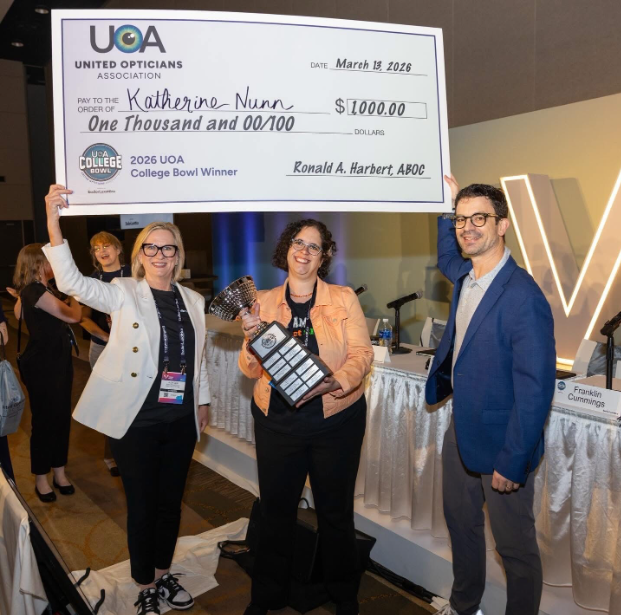
Today, we are proud to share the journey of our 2026 winner, Katherine Nunn. From over a decade in the jewelry business to the top of the podium, her story is a testament to the fact that it is never too late to find your path.
Transitioning from Jewelry to the Optical Industry
"I only came into the optical field a little under two years ago, having worked in my family’s jewelry store for over a decade," she shared with us. "We were facing the prospect of having to close our store as my parents were ready to retire, and the idea of possibly having to find a new career at my age was rather daunting."
Katherine found inspiration in a local friend, Christine Britt, owner of 20/20 Eyeworks in Chapel Hill, NC. "She suggested that I look into opticianry as a possible new career. The idea intrigued me; while I had no prior experience in the industry, I felt that my experience in retail and in jewelry repair might be transferable to optical in some ways."

Opticianry Education at Durham Technical Community College
Enrolling at Durham Tech brought its own set of nerves. "It was honestly daunting at first since it seemed like I was the only student in the program who was not currently working in the optical field. I felt as if I was already starting on the back foot."
However, that doubt didn't last long. "The more hands-on experience I had with glasses, learning how they work, and knowing that every pair represented a chance to help someone see, and by extension have a better quality of life, the more I knew that this was what I wanted to do."
The UOA College Bowl Experience at Vision Expo
When Katherine’s instructors nominated her for the College Bowl, her initial reaction was one of humility: "Are you sure you really want to send ME? I didn’t even know how to properly adjust my glasses just a year and a half ago!" "But I knew that I had to rise to the challenge," she said. "Not just for myself, but for my instructors, for my classmates, for my family, and for the person who inspired me to look into this career path in the first place."
A Remarkable Discovery on the Trophy
The victory brought with it a coda that felt like fate. She learned not long after the competition that another one of the names on the trophy was that of the father of one of her instructors, Terry Bennett.
"He had similarly faced the prospect of having to change his career later in life, not unlike I had, and ended up enrolling in the very same Opticianry program that I had! I guess this goes to show that it’s never too late to change your path in life or look for new ways to improve yourself. And in both of our cases, Durham Tech gave us the opportunity to do just that. They’re more than deserving of whatever honors we can earn for them.”
Reflections & Advice
We asked our champion what she took away from the College Bowl experience and what advice she would give to others:
On the Competition: "It was so much fun meeting fellow students from other schools... The competition was a bit nerve-wracking, of course, but the crowd had great energy, and it was nice to see everyone getting support… I also really enjoyed getting the chance to attend Vision Expo and seeing all the latest innovations and technologies in the optical industry.”
On Career Changes: "Always look for opportunities to transfer skills from your old career to your new one! For me, the biggest ones were retail/customer service experience, and jewelry repair, which has been useful when assembling and repairing frames. I have coworkers with backgrounds in fashion design and color styling which they apply to frame styling, purchasing, and merchandising. Even if you’re brand new to the optical field, you probably have some sort of expertise that can be of use."
On the Optical Community: "My classmates and teachers have been nothing short of amazing. We’ve worked together, supported one another, pulled each other through frustration, and cheered on the successes. I know we’ve all made some incredible friends and close colleagues for life."
A Better Place Than She Arrived
The inspiration Katherine found through her friend eventually led to a permanent home in the industry. "Incidentally, Christine is also now my employer! I have been working at 20/20 Eyeworks since last summer," Katherine noted.
As she embarks on this new chapter, our champion leaves us with a philosophy we can all admire:
"I firmly believe that one should leave every place that they go to better than when they arrived, and I aim to do just that in my new career in optical."

Congratulations again to our winner, Katherine Nunn, and the entire Durham Tech community!
About United Opticians Association
Founded in 2024, United Opticians Association (UOA) is the national organization representing opticians and accredited college programs across the United States. Dedicated to advancing the profession through education, credentialing, and advocacy, UOA serves as a unified voice for spectacle and contact lens opticians. By supporting national policy efforts and expanding professional training, UOA strengthens the workforce essential to quality vision care and advocates for the high standards necessary to ensure patient safety and public trust.
Learn more on our website at opticians.org.


Comments